

Pentest frameworks: comparison and selection 2026
Choosing the right framework is one of those decisions that separate an average audit from a test that actually reveals risk. The pentest tooling market today offers a dozen-plus serious options, from methodologies such as PTES and the OWASP Testing Guide, through full-featured exploitation platforms like Metasploit, all the way to autonomous systems like Pentera. The problem is not a lack of choice. It is that most specialists pick tools out of habit rather than methodically. This guide changes that pattern.
Table of contents
Key takeaways
| Point | Details |
|---|---|
| Mapping to MITRE ATT&CK | Choose frameworks with native ATT&CK integration so reporting carries business meaning, not just technical detail. |
| OWASP Top 10 is not a methodology | For web application testing use OWASP WSTG, not the Top 10, which is a threat-awareness document. |
| Automation will not replace the human | Autonomous tools like Pentera speed up testing, but logic flaws and advanced attack paths still require an expert. |
| Combine frameworks | Professional pentesters combine PTES, OWASP and OSSTMM for full coverage instead of relying on a single standard. |
| Cost does not determine quality | Kali Linux with Metasploit delivers broad technical coverage at low cost, but it does not replace methodology, reporting, scope documentation or the tester's experience. |
1. Criteria for evaluating pentest frameworks
Before we move on to specific tools and methodologies, it is worth establishing what actually separates a good framework from a bad one in operational terms. It is not about the number of features in the documentation, but about how the framework behaves in a real client environment.
Here are the criteria that genuinely matter:
-
Alignment with recognized methodologies. A framework should align with PTES, the OWASP Testing Guide or NIST SP 800-115. This guarantees repeatability and auditability of results.
-
Integration with MITRE ATT&CK. Mapping tests to ATT&CK lets you visualize attack-technique coverage and communicate audit results in a way that makes sense to management.
-
Testing scope. Does the framework cover networks, web applications, cloud environments and physical elements? A narrowly specialized tool needs to be supplemented.
-
Degree of automation. Automation speeds things up but limits the depth of analysis in complex scenarios. The balance between coverage and depth matters.
-
Reporting and compliance. Reports must meet regulatory requirements (ISO 27001, PCI DSS, NIS2). A framework that does not produce auditable documentation complicates work at the final stage.
-
Licensing model and cost. Open-source, commercial SaaS or PTaaS are three different cost models with different implications for small companies and large enterprises.
-
Support for advanced exploitation. Red teams need frameworks with mature C2 (command and control), OPSEC and the ability to simulate APTs.
Pro tip: Before choosing a framework, define the type of test: black box, grey box or red team. Different scenarios require different sets of tools and methodologies. Picking a tool without answering this question is the source of most mistakes.
2. Metasploit Framework
Metasploit is the absolute foundation of every pentester's toolkit. Metasploit Framework contains thousands of offensive modules, and Rapid7 currently describes it as a framework with over 4,000 exploit modules. It is one of the largest and most widely used publicly available module databases for penetration testing. The framework is available both in an open-source edition (Metasploit Framework) and a commercial one (Metasploit Pro).
A key advantage of Metasploit is its integration with MITRE ATT&CK metadata, which lets testers identify TTPs (Tactics, Techniques and Procedures) and map executed attacks onto the ATT&CK matrix. You will find a detailed discussion of this integration in the Metasploit guide.
Metasploit works best for infrastructure testing, vulnerability scanning and system exploitation. For red teams, its limitation is visibility in modern EDR environments. This is where Cobalt Strike comes in.
3. Cobalt Strike
Cobalt Strike is the standard for advanced red team operations and APT simulation. It provides the most flexible C2 infrastructure with advanced evasion features, malleable C2 profiles and the ability to simulate advanced threat groups.
The framework is commercial and expensive, but its capabilities in post-exploitation, lateral movement, persistence and C2 work are among the most extensive in the commercial red team tooling segment. Cobalt Strike is not a tool for beginners. It requires a solid understanding of OPSEC and red team infrastructure to avoid burning the operation early in the test.
It is also worth remembering that Cobalt Strike is heavily abused by APT groups, which means blue teams are increasingly well prepared to detect it. Effective use requires additional customization.
4. Burp Suite
Burp Suite Professional is the reference point for web application security testing. It fits well with testing conducted according to the OWASP Web Security Testing Guide, because it provides the proxy, scanner, Repeater, Intruder and workflow needed for manual and semi-automated verification of web vulnerabilities.
The tool offers a proxy, vulnerability scanner, intruder and repeater in a single environment. The Enterprise edition allows scan automation in a CI/CD pipeline. For web application pentesters, Burp Suite is the first-choice tool, regardless of whether the test is outsourced or run inside the organization.
An important distinction: OWASP Top 10 is a risk-awareness document, while OWASP WSTG is the actual testing framework. Burp Suite supports the latter, not the former. Confusing these two concepts is one of the most common mistakes when planning the scope of web testing.
5. Pentera and Horizon3.ai NodeZero
Autonomous platforms offer daily or weekly testing instead of annual point-in-time assessments. This is a fundamental shift in the security model: from a reactive audit to continuous verification.
Pentera automates the entire attack path: from reconnaissance through exploitation to reporting. NodeZero from Horizon3.ai works similarly, offering tests from the perspective of a genuine attacker, with no agents on target systems. Both tools target organizations that need frequent testing with a limited number of pentesters.
The line between these platforms and classic BAS (Breach and Attack Simulation) is blurring. Yet human testing remains irreplaceable for identifying advanced logic flaws and architectural errors that algorithms will not spot.
6. AttackIQ and SafeBreach - BAS platforms
AttackIQ and SafeBreach represent the Breach and Attack Simulation (BAS) category. They are built on a library of MITRE ATT&CK techniques and allow continuous testing of security controls against specific attack techniques.
Their strength is the ability to measure the effectiveness of existing defenses (EDR, SIEM, firewall) without engaging a pentester for every testing session. For a CISO, this is a tool for continuous risk management, not a classic audit. For pentesters, it is a useful part of the ecosystem that shows what the client's environment actually detects and what it lets through.
7. Methodologies: PTES, OWASP WSTG and OSSTMM
These are not tools but frameworks that define how to run a test. The difference is fundamental.
PTES is a 7-phase model defining the full penetration test cycle: from the engagement agreement, through reconnaissance and exploitation, to reporting. PTES standardizes scope and documentation, which directly supports compliance with audit requirements.
OSSTMM focuses on measuring and quantifying security through the RAV metric (Risk Assessment Value). This is a unique approach that sets OSSTMM apart from the other methodologies, focusing on operational protection of communication channels.
It is worth remembering that OSSTMM 3 is an older methodology from 2010. It can still be useful as a measurement framework, especially with the channel-based approach and the RAV metric, but in many modern projects you will more often encounter a combination of PTES, OWASP WSTG, NIST SP 800-115 and MITRE ATT&CK.
OWASP WSTG is a testing framework for web applications with over 90 test scenarios grouped into categories. Its use in the e-commerce and finance sectors is standard. You can read more about applying methodologies in practice in the piece on ethical hacking methodologies.
Professional pentesters combine PTES, OWASP and OSSTMM for full coverage rather than limiting themselves to a single methodology. That is practice, not theory.
8. Kali Linux as a working platform
Kali Linux is not a framework in the methodological sense, but a platform integrated with hundreds of pentesting tools. Nmap, Wireshark, John the Ripper, SQLmap, Metasploit, Burp Suite - they all work out-of-the-box.
Kali Linux with Metasploit delivers broad technical coverage across many scenarios at low cost, but it does not replace methodology, reporting, scope documentation or the tester's experience. For organizations that require auditable reports and management of testing campaigns, Kali is an environment, not a complete solution. It needs to be supplemented with a methodology (PTES) and reporting tools.
9. Pentest framework comparison table
The summary below covers the main characteristics of pentesting frameworks and tools according to key operational parameters.
| Framework / tool | Testing scope | Automation | Methodology | Reporting and compliance | Licensing model |
|---|---|---|---|---|---|
| Metasploit Framework | Network, systems, services | Partial | MITRE ATT&CK | Limited (Pro: better) | Open-source / commercial |
| Cobalt Strike | Red team, APT, C2 | Low (manual operations) | MITRE ATT&CK | Operational reports | Commercial |
| Burp Suite | Web applications | High (Enterprise) | OWASP WSTG | Detailed reports | Commercial |
| Pentera | Network, systems | Full (autonomous) | Internal, ATT&CK | Auditable, compliance | SaaS / PTaaS |
| NodeZero | Network, applications | Full (autonomous) | ATT&CK, PTES | Auditable | SaaS |
| AttackIQ / SafeBreach | Security controls | Full (BAS) | MITRE ATT&CK | Control-effectiveness report | Commercial SaaS |
| PTES | Full scope | None (methodology) | Own | Reporting template | Open (free) |
| OWASP WSTG | Web applications | None (methodology) | OWASP | Checklists | Open (free) |
| OSSTMM | Full scope (channels) | None (methodology) | Own (RAV) | RAV metrics | Free document / CC BY-NC-ND |
| Kali Linux | Full scope (platform) | Tool-dependent | Tool-dependent | Tool-dependent | Open-source |
10. Scenarios and framework selection recommendations
The right choice depends on the test context. Below are concrete recommendations for typical scenarios:
-
Web application testing (compliance, e-commerce, fintech). Use OWASP WSTG as the methodology and Burp Suite Professional as the main tool. Add PTES for scope documentation.
-
Advanced red team operations and APT simulation. Cobalt Strike with malleable C2 profiles, supplemented by Metasploit for vulnerability exploitation. Methodology: PTES or internal red team playbooks based on ATT&CK.
-
Continuous and autonomous security testing. Pentera or NodeZero for weekly verification of the attack surface. Especially effective for environments with highly variable infrastructure.
-
Compliance and regulatory testing (PCI DSS, ISO 27001, NIS2). PTES as the documentation framework, NIST SP 800-115 for technical structure, reports from Burp Suite or Pentera to attach to the audit.
-
Budget-constrained projects. Kali Linux with Metasploit Framework covers most scenarios. The PTES methodology is free. The cost is mainly the tester's time.
-
Internal infrastructure testing and lateral movement. Metasploit for exploitation, NetExec (the successor to the abandoned CrackMapExec) for Active Directory testing, Cobalt Strike for advanced persistence scenarios.
Modern PTaaS platforms combine automation with on-demand testers, which is an effective model for organizations without a permanent security team.
Pro tip: Do not pick a single framework as your only solution. Build a stack: methodology (PTES/OWASP), an exploitation tool (Metasploit/Cobalt Strike), a web testing tool (Burp Suite) and a reporting tool. The result is an audit covering the full scope that holds up against questions from the client and the auditor.
Expert opinion: how I choose frameworks in practice
Over years of working with different clients and environments, I have learned one thing: the biggest mistake when choosing a tool is starting from the tool instead of the question of what we want to check.
I have seen projects where a company spent tens of thousands of euros on Cobalt Strike, while the tester used it like a richer Metasploit, with no C2 or OPSEC strategy at all. The results were weaker than a well-planned test with open-source tooling. The tool does not make the test. The methodology makes the test.
My approach: I start from PTES for structure, match tools to the test scope, and use the ATT&CK Navigator to visualize technique coverage. The result is auditable, defensible and understandable for the client's management, not just for technical staff.
I am also skeptical of the full-automation trend. Autonomous tools like Pentera do a great job uncovering known attack patterns, but complex attack paths that require business context still need a human contribution. The value of a pentest lies in methodology, not just in tools.
Watch the market, but do not chase every novelty. A framework you know well and apply methodically is worth more than ten tools used halfway.
Pentesting hardware and tools at Sapsan-sklep
Software frameworks are only part of the puzzle. Effective network testing, RFID, physical security audits and hardware testing require dedicated equipment.
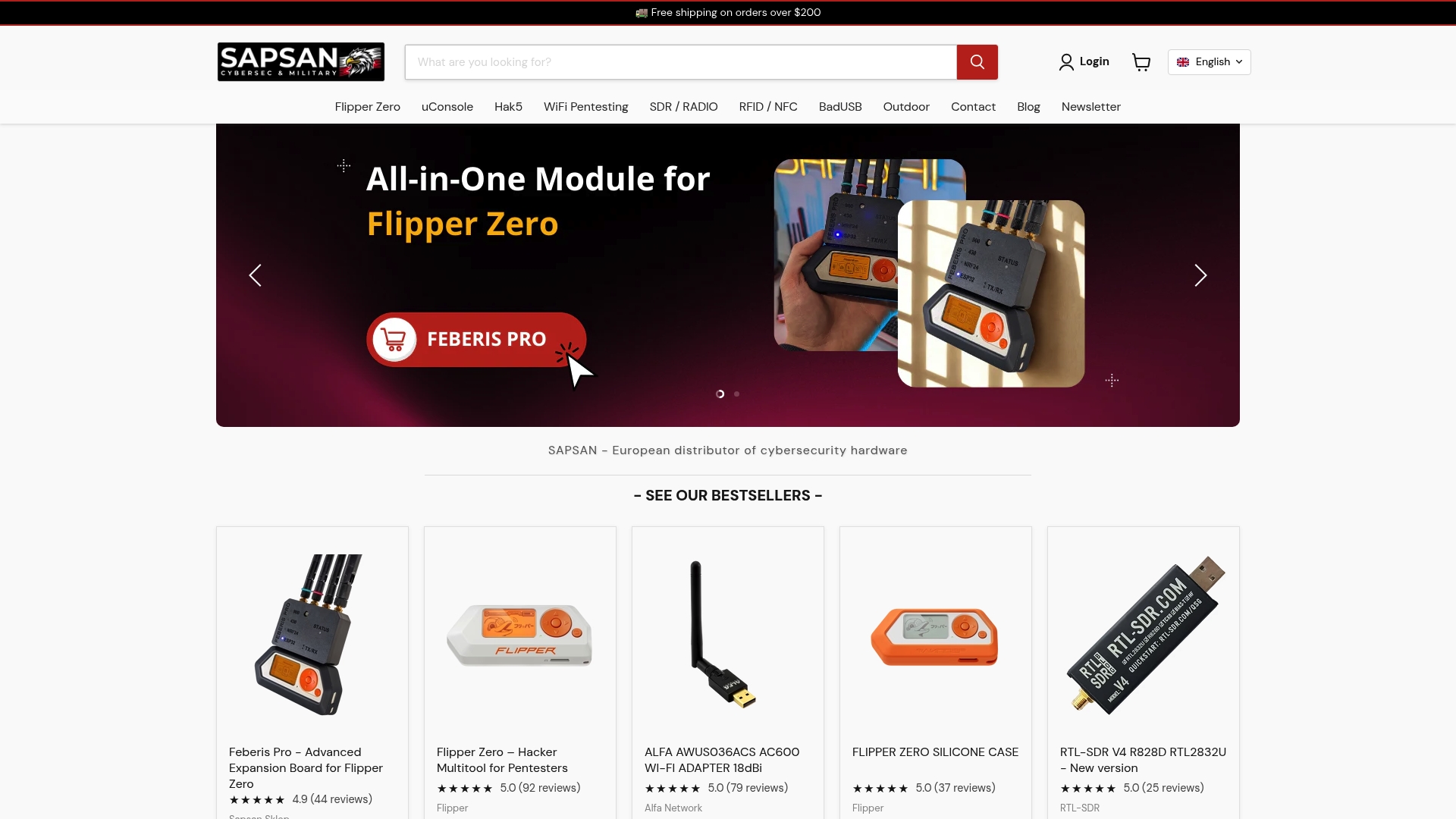
Sapsan-sklep, as a European distributor of specialized hacking equipment, offers tools compatible with the frameworks above: Hak5 devices such as the Packet Squirrel Mark II for network testing, BadUSB hardware, RFID/NFC tools and the Flipper Zero with accessories. The full range is available with delivery across the EU and the USA. The offering is aimed both at professional pentesters and at IT security teams looking for equipment for physical and network audits.
FAQ
Which framework is best for beginner pentesters?
Kali Linux with Metasploit Framework is the optimal starting point. The combination of open-source, rich documentation and compatibility with the PTES methodology provides a solid foundation with no licensing costs.
What is the difference between OWASP Top 10 and OWASP WSTG?
OWASP Top 10 is a threat-awareness list, not a testing methodology. For actual web application security testing you use the OWASP Web Security Testing Guide (WSTG), which contains over 90 detailed test scenarios.
Do autonomous platforms like Pentera replace manual testing?
They do not replace it entirely. Autonomous platforms speed up the verification of known attack patterns and excel at continuous monitoring, but advanced logic flaws, architectural errors and complex attack paths require an experienced pentester.
How does MITRE ATT&CK mapping improve the quality of pentest reports?
The ATT&CK Navigator enables visualization of covered attack techniques, which lets you communicate test scope and coverage gaps to both technical staff and management without having to translate offensive terminology.
Can PTES and OWASP WSTG be used at the same time?
Yes, and it is the recommended practice. Professional pentesters combine methodologies for full coverage: PTES defines the project structure and documentation, while OWASP WSTG specifies the test scenarios for web components.