

The Role of Flipper Zero in Pentests: A Practical Guide
Flipper Zero is often portrayed as a device capable of anything: opening cars, cloning cards, hijacking networks. That narrative dominates the media and forums, but it misses reality. The role of Flipper Zero in pentests is specific, documented and valuable - yet completely different from what the popular story suggests. This article breaks down the device's actual capabilities, its limitations, and the modern projects that extend its functionality in professional penetration testing.
Table of contents
- Key takeaways
- The role of Flipper Zero in pentests: capabilities and limitations
- FlipperAgent: automating the pentest cycle
- Feberis Pro: extending the Flipper with real capabilities
- RF analysis and protocol fingerprinting
- My hands-on experience with Flipper Zero
- Flipper Zero pentest gear at Sapsan-sklep
- FAQ
Key takeaways
| Point | Details |
|---|---|
| Flipper Zero has concrete limitations | The device does not break modern encryption, nor does it clone cards with dynamic security mechanisms. |
| Projects like FlipperAgent automate the workflow | Structured pentest phases (recon, exploit) increase efficiency and reduce operational errors. |
| Feberis Pro extends the Flipper with several radio modules | Two CC1101 chips for 433/868 MHz, NRF24 for 2.4 GHz, ESP32 with Wi-Fi 2.4 GHz, and GPS for location mapping during wardriving. |
| Firmware requires active management | CVE-2026-30363 shows that firmware version control is an obligation, not an option. |
| Flipper Zero in RF is a research tool | The flipper-rf-lab platform provides fingerprinting and spectrum analysis across 300-928 MHz. |
The role of Flipper Zero in pentests: capabilities and limitations
Flipper Zero is a multi-protocol device for hardware audits, formally classified as a security research multi-tool. It supports Sub-GHz, RFID/NFC and infrared (IR) communication, which translates into specific use cases in penetration testing of physical and wireless systems.
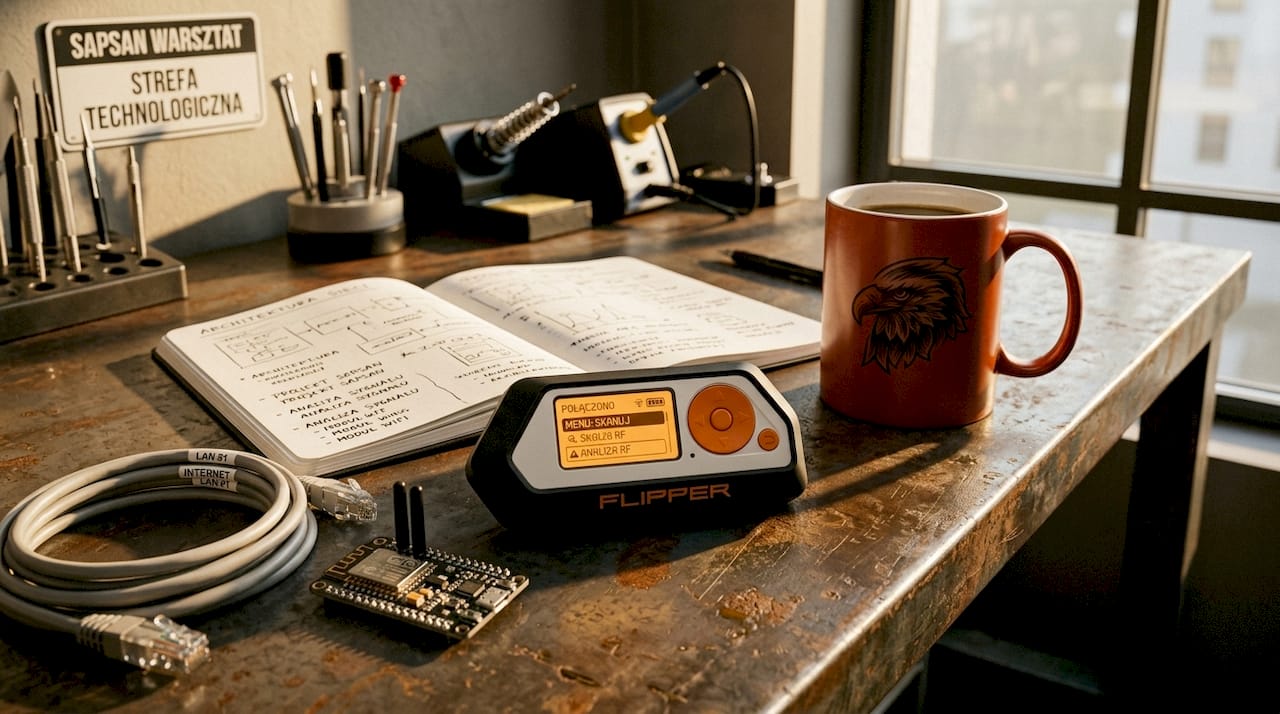
Sub-GHz on the Flipper Zero operates in three bands within the 300-928 MHz range (with gaps between them), including the popular 433 and 868 MHz. The device records and replays signals used by remotes, alarm sensors or garage gates. That is enough to identify weak points in systems based on fixed codes. Rolling codes in modern cars, however, remain out of reach for the Flipper Zero, which does not analyze algorithms of this type.
The situation with RFID/NFC is similar. The device reads card UIDs, emulates tags and records signals. However, reading a public UID does not translate into the ability to clone cards with dynamic security mechanisms. In practice, full cloning or emulation with usable access mainly concerns legacy, unencrypted, weakly protected or misconfigured protocols. With cards such as MIFARE DESFire or MIFARE Plus, reading the UID alone is not enough to create a working clone; at most you can read the UID or unprotected data, depending on the card's configuration.
What the Flipper Zero does not have built in:
- A Wi-Fi module (requires a separate WiFi DevBoard)
- The ability to crack cryptographic keys
- Support for Bluetooth 5.x protocols in active attack mode
- A full TCP/IP network stack without additional extensions
Pro tip: Before adding the Flipper Zero to your pentest toolset, match its features to the specific protocols of the target environment. The device is valuable as a tool for spotting weak points where systems use unencrypted or outdated protocols.
A key shift in how to think about this hardware: the Flipper Zero is an audit tool, not an offensive one in the full sense of the word. Its value in pentests lies in detecting vulnerabilities in existing systems, not in breaking enterprise-grade security.
FlipperAgent: automating the pentest cycle
FlipperAgent is an agent-based architecture that integrates the Flipper Zero with a system for managing the full penetration testing cycle. It is a qualitative shift in how testing with this device is approached.
FlipperAgent supports over 67 tools covering BLE, WiFi, Sub-GHz, IR and NFC/RFID. The agent guides the pentester through structured phases:
- Recon - passive gathering of information about the target environment, identifying active protocols and devices.
- Research - categorizing discovered assets, searching for known vulnerabilities for the identified protocols.
- Enumerate - active mapping of the system, identifying configurations and component versions.
- Exploit - executing offensive actions that require explicit user approval.
- Report - generating a structured report with test results and recommendations.
The exploit phase has a built-in control mechanism. The workflow requires user approval before every high-risk action. This is a by-design safeguard against accidentally executing destructive operations in a production environment.
Pro tip: When setting up FlipperAgent, start with recon mode in an isolated test environment. The agent collects a significant amount of data about the environment, which requires agreeing on the scope with the client in advance under the testing contract.
The agent-based approach solves one of the real problems of working with the Flipper Zero: the lack of structure in multi-stage tests. By automating the pentest phases, you can reduce errors caused by skipped steps and standardize the reporting format. This matters especially for repeatable tests, where methodological consistency directly affects how comparable the results are over time.
Feberis Pro: extending the Flipper with real capabilities
Earlier we listed what the Flipper Zero lacks out of the box: a Wi-Fi module, greater Sub-GHz range, support for 2.4 GHz peripherals. Instead of buying and swapping several separate boards, you can reach for a single module that combines these functions. Feberis Pro is our own All-in-One expansion module, designed for real pentest scenarios.
| Module | Band | Use in pentests |
|---|---|---|
| 2x CC1101 | 433 / 868 MHz | Boosted Sub-GHz range, cloning remotes from a greater distance, testing 433/868 MHz systems |
| NRF24 | 2.4 GHz | MouseJack - testing wireless keyboards and mice, analyzing 2.4 GHz protocols, detecting vulnerable devices |
| ESP32 + Marauder | WiFi 2.4 GHz | Scanning and recon of WiFi networks without a separate DevBoard |
| GPS | - | Mapping network coverage with coordinate logging (wardriving) |
Everything switches via a jumper system, and each band has a tuned antenna. In practice this means one device instead of four and less swapping in the field. The module comes preinstalled and is ready to work right after connecting to the Flipper's GPIO port.
Pro tip: Set the jumpers to the module matching the test phase - WiFi recon (ESP32) separately, Sub-GHz analysis (CC1101) separately. Keeping a single radio active at a time simplifies interpreting results and reduces mutual interference.
Full specs and availability: Feberis Pro at Sapsan-sklep.
RF analysis and protocol fingerprinting
The flipper-rf-lab project turns the Flipper Zero into a platform for lab-grade radio-wave analysis. The 300-928 MHz range covers many popular Sub-GHz protocols used in IoT, access control and automation, but it does not include systems operating outside that range, e.g. some 2.4 GHz solutions, Wi-Fi, BLE, Zigbee or cellular bands.
Key features of flipper-rf-lab:
- Device fingerprinting - identifying the unique signal characteristics of specific transmitters based on physical transmission traits
- Spectrum monitoring - continuous observation of activity across a frequency range with anomaly logging
- Threat classification and scoring system - automatic categorization of detected protocols by risk level
- Signal clustering - grouping similar transmissions using statistical algorithms to identify patterns
Timing precision of 0.1 μs is the parameter that determines the reliability of RF-forensic measurements. In tests that require distinguishing similar protocols or documenting signal characteristics for a report, that temporal resolution is sufficient for most audit use cases.
flipper-rf-lab supports session comparison, fingerprinting and signal clustering, which can make repeatable analysis in audits easier. I would not, however, treat it as a replacement for certified measurement equipment or a full SDR in scenarios that require metrological accuracy.
For tests requiring deeper RF spectrum analysis beyond the Flipper Zero's range, a useful complement is the HackRF One with PortaPack H4M, which covers 1 MHz to 6 GHz. The Flipper Zero and HackRF One complement each other well in a lab workflow, where the Flipper handles quick operational tests and the HackRF takes on in-depth analysis.
My hands-on experience with Flipper Zero
I have been working with the Flipper Zero since it went beyond the narrow circle of early adopters, and I quickly confronted the marketing with reality. In short: it is not a universal key to everything. It is a scalpel for specific, poorly secured protocols - and that is exactly where it shines.
The first thing visible in practice: the Flipper is great at exposing old, unencrypted systems, but with modern encryption or rolling code it simply stops. And that is valuable diagnostic information, not a failure. If a gate, reader or remote does not yield to a tool of this class, it means someone did their homework - and that is exactly how I report it to the client.
The second thing, badly underrated: the pentester's own gear is an attack surface too. CVE-2026-30363, a stack buffer overflow allowing code execution with local access (CVSS 8.4), is a reminder that firmware must be taken seriously. In my work, every device that goes into the field has a verified firmware version and controlled payloads. Physically isolating the hardware is not paranoia - it is work hygiene.
The third observation: workflow-automation projects like FlipperAgent are worth the configuration time up front. The first session with the agent takes longer than a manual test, but every next one is faster and repeatable. For recurring audits of the same client, that is a real time saving and more consistent reports.
The Flipper Zero with the right extensions is a tool with concrete operational value. Without knowing its limits, it stays just a pricier gadget.
- Krystian
Flipper Zero pentest gear at Sapsan-sklep
Sapsan-sklep supplies the Flipper Zero and a complete ecosystem of accessories and expansion modules for pentesters and IT security specialists across the European Union and the USA.
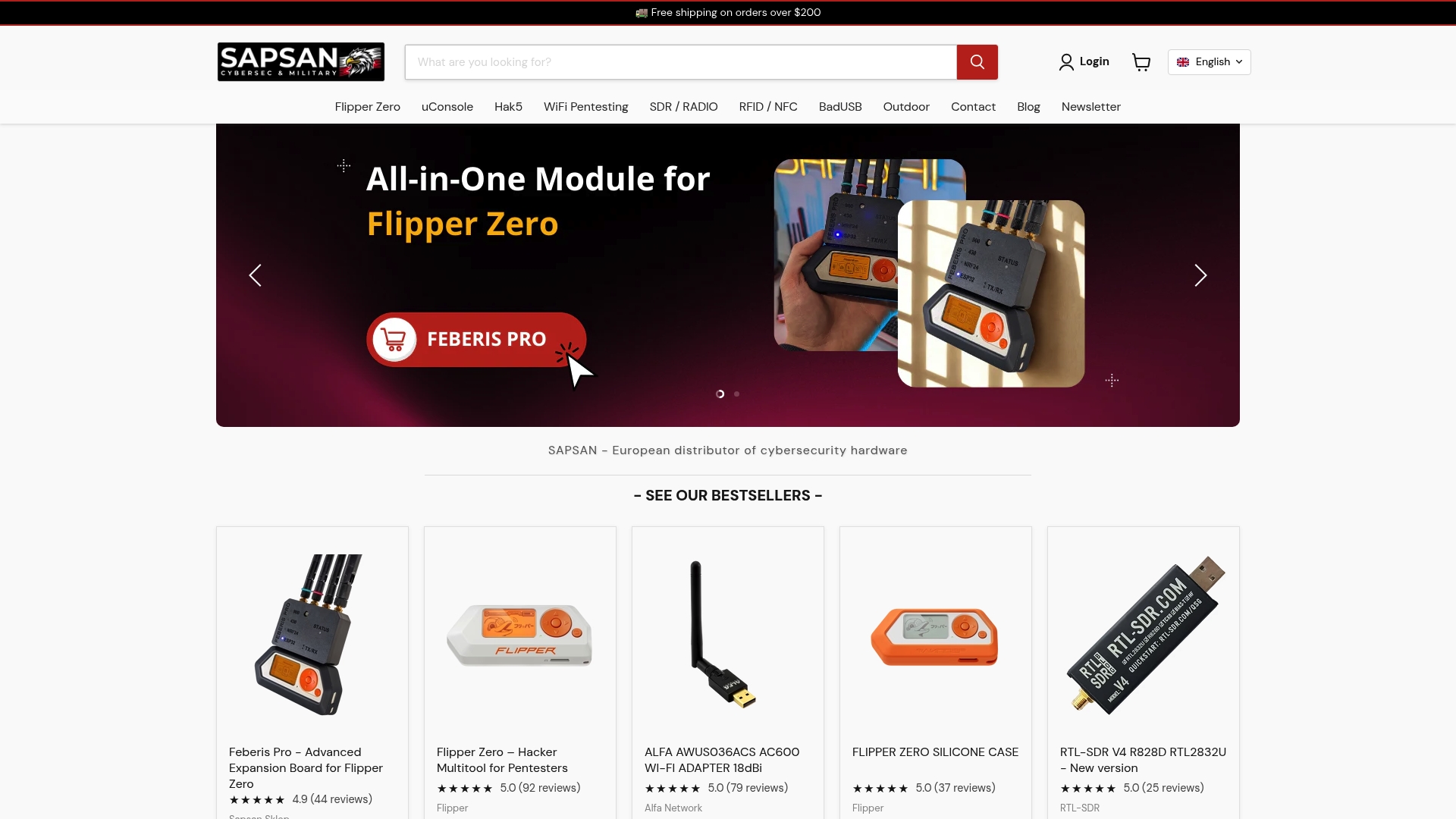
Sapsan-sklep's range includes, among others, the Flipper Zero in its standard version, our own All-in-One module Feberis Pro, the WiFi DevBoard for wireless network testing, and the prototype board for your own hardware integrations. The full range of gear and accessories for professional pentests includes SDR tools, BadUSB hardware and RFID/NFC testing devices. Shipping is fast, with products ready for immediate dispatch.
FAQ
What can the Flipper Zero do in pentests?
The Flipper Zero identifies weak points in systems using unencrypted Sub-GHz protocols, reads RFID/NFC card UIDs, emulates IR signals and records radio transmissions. Its use in pentests is primarily about auditing existing vulnerabilities, not actively breaking encryption.
Can the Flipper Zero clone encrypted NFC cards?
No. The device reads a card's public UID, but it does not extract the private keys needed to create a working clone of cards with dynamic security, such as MIFARE DESFire.
How do you extend the Flipper Zero's capabilities?
The simplest way is an All-in-One module. Our Feberis Pro adds two CC1101 chips (433/868 MHz) for greater Sub-GHz range, NRF24 for 2.4 GHz peripheral testing (MouseJack), ESP32 with WiFi and Marauder, and GPS for coverage mapping - all in one device, switched via a jumper system. Alternatively, you can assemble separate modules (e.g. a WiFi DevBoard) for specific tasks.
What are the risks associated with Flipper Zero firmware?
CVE-2026-30363 (GHSA-3ffr-g93x-5957) is a stack buffer overflow in the Main function, in a specific flipperzero-firmware commit (ad2a80). The advisory is rated High / CVSS 8.4 with a local vector, but it lists unknown affected versions and unknown fixed versions - so the most honest way to describe it is as an issue of a specific commit or derivative builds. In practice: control your firmware version, the payloads you load and physical access to the device.
Is the Flipper Zero effective without additional modules?
For Sub-GHz, IR and basic RFID, yes. Wi-Fi testing requires a separate module (a WiFi DevBoard or our Feberis Pro), and advanced RF analysis relies on projects like flipper-rf-lab. The Flipper Zero alone, without extensions, covers a specific but limited range of protocols.